Advanced Process Control
Operational Excellence
Digital Transformation

Over the past decade, refineries and petrochemical plants have invested heavily in data.
Historians were upgraded.
Data lakes were built.
Cloud pipelines were deployed.
Data science teams were hired.
The promise was compelling: once operational data became accessible, structured, and scalable, better decisions would follow.
And yet, in many plants, decision speed and operational clarity have not materially improved.
As explored in Why APC Underperforms in Practice, performance gaps in advanced control are often not technical failures — but structural ones.
Control rooms are still slow during disturbances.
Engineers still reconcile conflicting signals manually.
Optimization windows still close before action is taken.
The problem isn’t a lack of data.
It’s something deeper.
The industry may be caught in what we can call the Data Foundation Trap.
Data infrastructure is essential. Without it, modern operations cannot function.
Data platforms solve real problems:
Centralized storage
Structured access
Historical visibility
Cross-site analytics
Enterprise reporting
They create transparency.
But transparency alone does not create decisions.
Data answers questions like:
What happened?
What changed?
How often?
How far from target?
It does not answer:
What should we prioritize right now?
Which constraint truly binds?
How do planning, maintenance, and safety shift today’s optimal move?
What trade-off matters most in this moment?
Those are reasoning questions.
And reasoning is not the same as data availability.
The trap emerges when organizations assume that once the data foundation is complete, the decision layer will naturally emerge on top of it.
It doesn’t.
In theory, better visibility should reduce uncertainty.
In practice, it often increases complexity.
More signals mean:
More trends to monitor
More dashboards to consult
More cross-functional data streams
More contextual variables to reconcile
Data scales visibility.
But it also scales ambiguity.
Consider a unit approaching a constraint.
The historian shows temperature drift.
The planning system indicates downstream demand softening.
Maintenance notes a compressor nearing inspection hours.
An optimizer suggests increasing throughput.
Every system is technically correct.
But none of them reconciles the whole picture.
So the reconciliation happens manually.
The engineer checks another screen.
The operator reviews yesterday’s shift notes.
A phone call confirms maintenance status.
The process slows — not because information is missing, but because interpretation is fragmented.
This is not a data problem.
It is an architectural one.
The Data Foundation Trap carries a subtle but measurable economic impact.
When decisions require manual stitching across systems, plants tend to become conservative.
Constraints are respected earlier than necessary.
Throughput is reduced preemptively.
Energy margins are protected rather than optimized.
Small conservative adjustments accumulate.
Across a refinery, even a 1–3% efficiency gap can represent millions annually in lost margin, energy overspend, or off-spec exposure.
During disturbances, the cost compounds.
If root cause clarity takes 45 minutes instead of 15, throughput drops.
If constraint uncertainty lingers, rate reductions persist longer than required.
If optimization is delayed, favorable windows close.
None of these losses appear in a dashboard labeled “Missing Reasoning.”
But they exist.
And they are systemic.
The industry’s digital architecture today typically includes two strong pillars:
1. Data Infrastructure
Centralized, structured, accessible.
2. Optimization Engines
Capable of calculating mathematically optimal moves within defined constraints.
These pillars are powerful.
But between them lies a gap.
Data provides visibility.
Optimization provides action.
What connects them?
Context.
Interpretation.
Trade-off reasoning.
In many plants, this middle layer exists only in human expertise.
Experienced operators and engineers:
Interpret conflicting signals
Adjust constraints dynamically
Reconcile planning priorities
Recall historical behavior
Weigh short-term vs long-term risk
In Beyond the Algorithm: Why People Decide APC’s Fate, we examined how planning, maintenance, and scheduling priorities shape operational decisions in ways that raw optimization cannot capture alone.
They perform contextual reasoning constantly.
But the digital stack does not formally represent this layer.
The architecture effectively looks like this:
Data → (human reconciliation) → Optimization → Action
As long as human expertise is abundant and stable, the gap is manageable.
But two forces are increasing pressure:
Data volume continues to grow.
Experienced personnel are retiring faster than they are replaced.
The burden on the human middle layer is expanding — not shrinking.
The oversight was subtle.
As digital transformation accelerated, organizations focused on:
Building better foundations (data platforms)
Adding smarter rooftops (AI and optimization)
The middle was assumed.
But no system formally integrated:
Operational context
Maintenance realities
Planning shifts
Constraint interpretation
Institutional logic
Without that integration, decision-making remains distributed across tools and people.
The plant becomes digitally visible — but not structurally coherent.
The result is a paradox:
More digital investment. But similar decision friction.
More data availability. But similar reconciliation effort.
More optimization potential. But similar conservatism during uncertainty.
The foundation is strong.
The rooftop is sophisticated.
The structure in between is unfinished.
A common assumption in digital programs is that once data is accessible, insight becomes easier.
But insight is not simply information exposure.
Insight requires:
Prioritization
Contextual framing
Causal interpretation
Consequence prediction
Alignment with operational reality
Dashboards show what changed.
Historians show trends.
Optimizers compute objectives.
As discussed in Breaking Down the Black Box: When AI Explains Itself, explainability improves trust — but trust alone does not resolve architectural fragmentation.
But none of these inherently answer:
“What matters most right now?”
When visibility outpaces structured understanding, cognitive load increases.
Decision-makers must:
Filter noise
Resolve contradictions
Interpret implications
Validate constraints manually
The decision process remains human-intensive — even if the data infrastructure is modern.
This is the Data Foundation Trap.
Organizations feel digitally mature because information is accessible.
Yet decision architecture remains partially analog.
Perhaps the issue is not whether plants need more data or better optimization.
Perhaps the real question is architectural:
What layer translates information into coherent, contextualized judgment?
If we map industrial intelligence structurally, it might look like this:
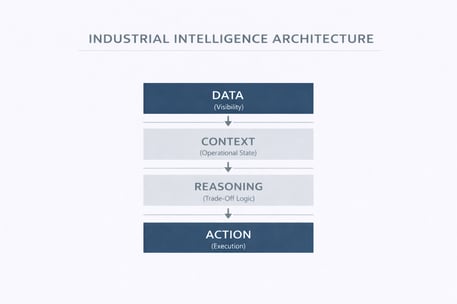
Most plants have invested heavily in Layer 1.
Some have implemented strong Layer 4 capabilities.
But Layers 2 and 3 — the integration of context and structured reasoning — often remain informal, distributed, and dependent on individual expertise.
As long as those layers remain implicit rather than architectural, decision friction persists.
Not because people are incapable.
Not because data is insufficient.
But because the stack itself is incomplete.
If data is the foundation, what completes the structure?
If optimization executes action, what ensures that action fits today’s operational reality?
If insight depends on contextual reasoning, should that layer remain informal — or should it become part of the architecture?
In the next post, we’ll explore why optimization alone cannot fill this gap — and why acting faster does not necessarily mean acting smarter.
For plants that have invested heavily in data yet still experience decision bottlenecks, the issue may not be execution.
It may be that the middle of the structure was never fully built.
If your plant has invested heavily in data infrastructure but operational decisions still require manual reconciliation across systems, the issue may not be visibility — it may be the missing reasoning layer.
We are working with selected refinery and petrochemical teams to evaluate whether a structured reasoning layer can accelerate decision speed and recover hidden operational efficiency.